St. Boniface RC Primary School
Writing
Every child a confident, purposeful writer
At St Boniface, writing is taught as a thoughtful, creative journey. We want every child to write with confidence, control and a growing sense of their own voice. Children learn how to shape language for a clear reason and audience, drawing on rich vocabulary, accurate grammar, secure spelling and fluent handwriting.
Our curriculum is rooted in high-quality picture books, novels, film and poetry. Carefully chosen texts open doors to new worlds and viewpoints, while meaningful links with history, geography, science, RE, art and PSHE give children genuine knowledge to write about. Quality matters more than quantity: children are given time to talk, explore, practise, craft, improve and publish writing they can be proud of.
Our whole-school writing approach
Strong sentence foundationsEach year begins with focused PVPG teaching. This revisits the building blocks of sentences, punctuation and grammar so that every pupil has a secure foundation for the writing ahead. |
Purpose before productChildren know why they are writing, who will read it and the effect they want to create. Our RAFT framework keeps purpose and audience at the heart of every outcome. |
Live modelling and talkTeachers model the decisions writers make in real time. Oracy is woven through each unit so children can rehearse ideas, explore vocabulary and hear how sentences work before committing them to the page. |
Responsive teachingAssessment happens throughout the journey. Teaching is adapted from pupils' starting points, prior learning is revisited where needed and every child receives the scaffolding or challenge that helps them move forward. |
PICC: the journey from idea to finished writing
PICC gives every class a consistent, memorable route through a writing unit. The length of each stage changes to suit the text, outcome and needs of the children.
1. PredictA powerful hook creates curiosity. Children make predictions, explore the context and begin to gather ideas. |
2. InterrogateWe read as writers: examining vocabulary, sentence choices, structure, viewpoint and the craft behind a quality model. |
3. CaptureChildren collect, organise and refine the language, knowledge and techniques they will need for their own outcome. |
4. CreateChildren plan, draft, edit and improve. Creation may span several lessons so that sustained quality—not rushed completion—comes first. |
RAFT: writing with real purpose
R — ReasonWhy am I writing? |
A — AudienceWho am I writing for? |
F — FeaturesWhat will make it effective? |
T — ToneHow should it sound and feel? |
RAFT is revisited throughout the unit and is visible in children's books. It helps pupils make deliberate choices rather than simply reproduce a text type.
Writing classrooms that grow with the learning
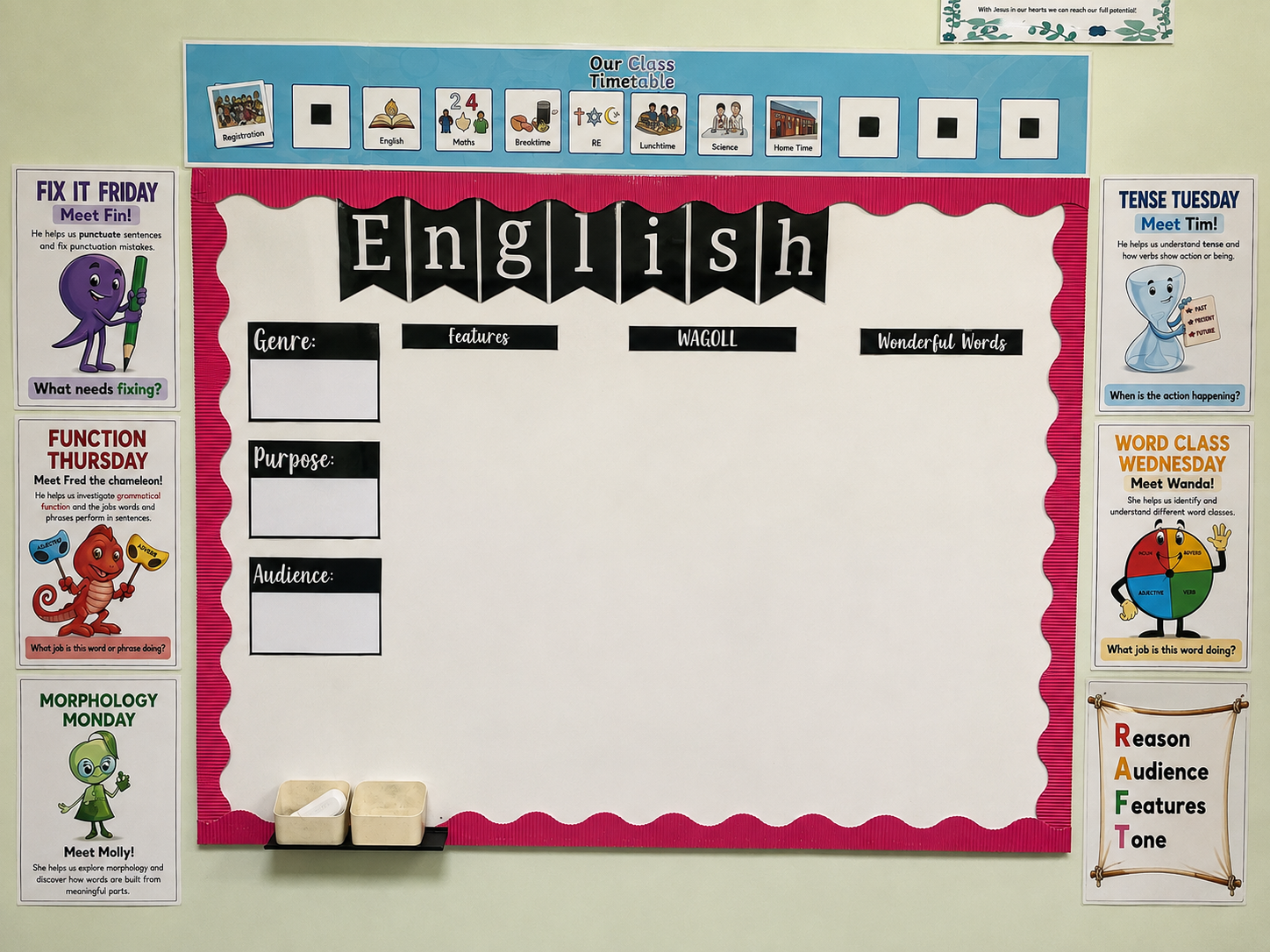
Working wallsSimple, consistent working walls are built with the class. They make the current genre, purpose, audience, features, model writing and ambitious vocabulary visible and useful. |
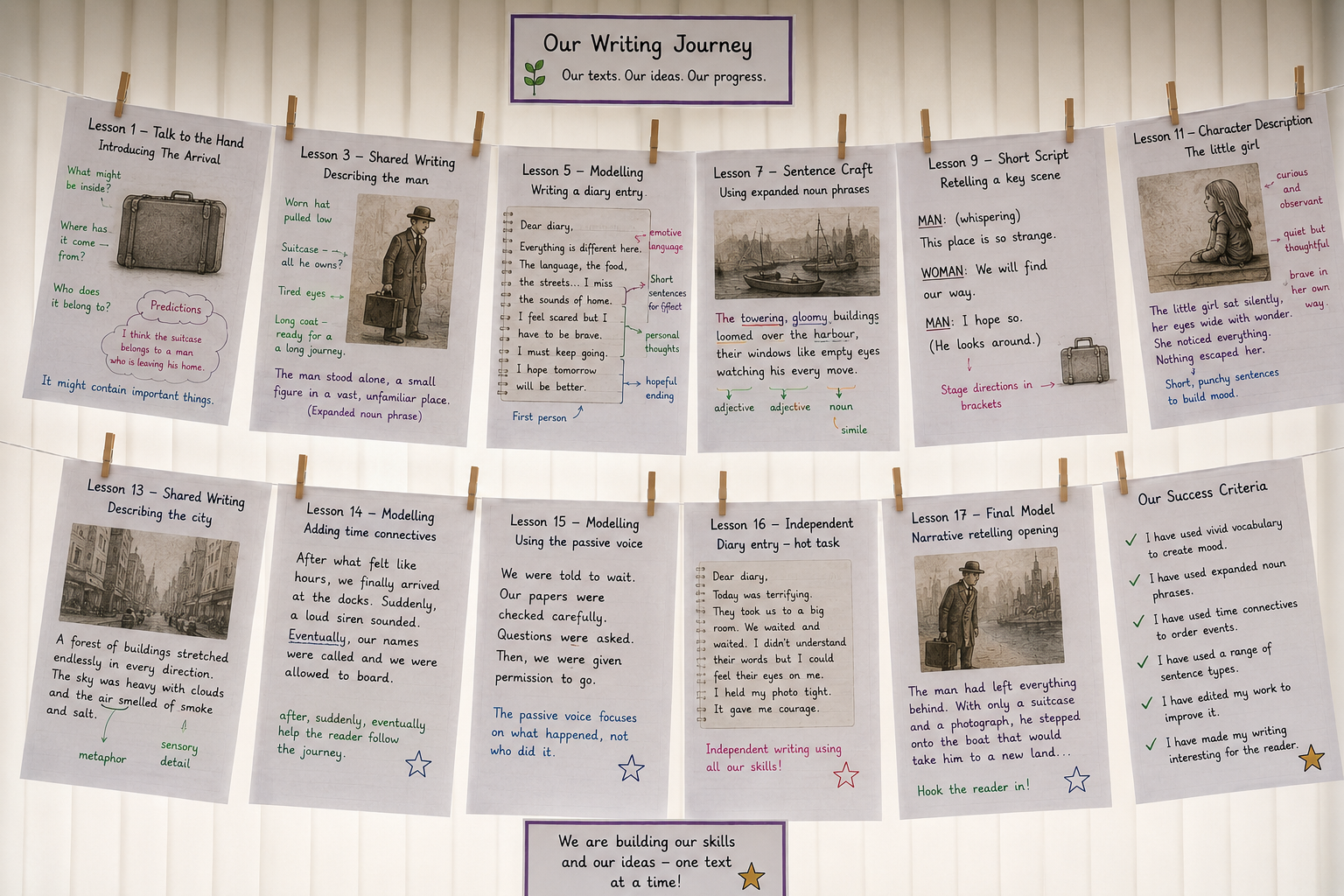
Washing linesModelled writing, shared writing and carefully chosen pupil examples are displayed across the unit. Children can see how ideas develop and return to earlier learning independently. |
The tools of a writer
Grammar and punctuation
Grammar is taught in context and applied immediately. Purposeful daily starters revisit handwriting, sentence accuracy, spelling and vocabulary. Across the week, memorable routines develop morphology, tense, word class, grammatical function and careful proofreading. Teachers use pupils' responses to decide what needs revisiting, extending or embedding.
Spelling
Spelling teaching builds from phonics and develops through patterns, word families, morphology and etymology. In Key Stage 2, Emile provides explicit teaching, practice and later retrieval. Weekly checks and ongoing assessment reveal gaps so that teaching can respond quickly, while repeated practice helps new learning move into long-term memory.
Handwriting
Fluent, legible handwriting frees children to concentrate on composition. Pupils are taught correct posture, tripod grip, letter formation and joining through a carefully sequenced programme. Handwriting is taught consistently in Years 1 and 2 and at least twice times each week in Years 3 to 6, with further practice built into English lessons. Children move from pencil to a fine-nib ink pen when they are ready.
Progression, assessment and inclusion
Our progression documents set out the carefully sequenced knowledge pupils build from Year 1 to Year 6 across composition, grammar, punctuation, spelling and handwriting. Year-group writing plans connect rich texts with purposeful outcomes and curriculum links; end points make the expected learning clear.
- Teachers assess during every stage of the writing journey and use this evidence to shape the next lesson.
- Oral rehearsal, shared writing, vocabulary support, sentence scaffolds and adapted starting points ensure that all pupils can participate and succeed.
- Where foundations are not yet secure, teachers revisit earlier learning before moving on.
- Children evaluate and edit their own work, respond to feedback and learn that improvement is a natural part of being a writer.
At St Boniface, children do not simply complete pieces of writing. They learn to think, talk and make choices like writers.
Curriculum documents
The downloadable documents below show our whole-school progression, year-group plans, end points and handwriting sequence. Together they explain what children learn, the high-quality texts that inspire them and how knowledge develops over time.